
Josephine County Crime News
Start with the agency that put out the announcement. JCSO uses FlashAlert and its own News and Events pages, which carry selected incidents and public-safety material rather than a full booking log. Grants Pass Police runs its own selective FlashAlert stream. A release might mention that someone was lodged at the Josephine County Adult Jail. Even so, it describes one event. It does not confirm current custody or a case outcome.
Local outlets fill in what an agency release leaves out. KAJO posts frequent short law-enforcement briefs. Illinois Valley News has a distinctive monthly Police Blotter and Tales From the Rural Patrol pattern covering Cave Junction, Kerby, Selma, and rural valley calls. KRRM carries a similar regional short-news stream. The Daily Courier and KTVL cover the county and southern Oregon too, though their stories are driven by events rather than serving as a daily jail index.
Put together, this landscape helps you pin down a date, an agency, an incident label, or a court lead. It is no substitute for the official roster, JCSO Records, the proper city records office, or the Circuit Court.
Josephine News Outlet Records
Official streams come first on this list. News pages and third-party county sections can work as secondary starting points, but they have real limits. Some omit records. Some keep old material around. Others describe a case differently than the court does. A third-party mugshot label, for its part, tells you nothing about whether JCSO currently displays or releases a booking photo.
| Outlet or source | Coverage | Photos? | Where to look |
|---|---|---|---|
| JCSO FlashAlert | Selected sheriff public-safety releases | Case-specific attachments may occur | Official release stream |
| Grants Pass Public Safety | Selected city police releases | Not a routine gallery | Official city release stream |
| Illinois Valley News | Monthly rural patrol and police-blotter reports | No routine booking gallery | Police Blotter archive |
| KAJO 99.7 FM | Frequent local arrest, dispatch, and lodging briefs | No routine gallery found | Local News index |
| KRRM | Regional short briefs, often parallel to KAJO | No routine gallery found | Regional News index |
| Daily Courier and KTVL | County-seat and event-driven regional reporting | Case-specific agency or scene images | Daily Courier and KTVL Local News |
| County aggregator pages | Unofficial, variable or historical coverage | Varies by independent service | RecentlyBooked, Mugshots.com, and Arrests.org county pages |
RecentlyBooked has a county page describing a 30-day view. Mugshots.com looks historical for Josephine County. Arrests.org had variable recent coverage. Treat each one as secondary to the official record, and lean on none of them for a current custody status.
Josephine News Photo Limits
Where a picture comes from matters. JCSO may publish a dated public-safety release. A reporter may attach an agency image or a scene photo to a story. None of that makes a county booking photo generally available. The public Jail Inmate Inquiry shows no image field. Oregon's ORS 133.870 restricts agency release of booking photos except in listed circumstances.
News outlets make their own editorial calls. They may update, correct, or keep articles in ways that differ from the agency. A story that runs a photo does not turn it into an official roster record. For the county's full booking, photo-law, and records-request explanation, see the Josephine County home guide.
Curious about how a case ended? The court record holds the answer, since news coverage alone won't show the final outcome.
Josephine Story Record Path
Work from the details a story gives you. A full name, an incident date, an arresting agency, a case number, or a booking period can steer the search. Just don't treat the article as the final word. The county's official jail viewer accepts a name, a Subject Number, a Booking Number, a current-custody control, a booking-date range, and a facility selector. One thing it lacks is a booking photo in the observed public interface.
- Read the story for the agency, date, and any record or case identifier.
- For local adult custody or a known booking period, search the JCSO Inmate Inquiry with the right date and custody setting.
- If a booking record is needed and the viewer does not answer the question, use JCSO's focused records-request process.
- Use the Oregon Judicial Department case route for the court events and disposition that occur after booking.
A current-custody search answers a different question than a date-range search. Pick In Custody and someone released from the local jail may not show up. A person sentenced to state custody moves into Oregon DOC's system. Federal and ICE questions go to their separate locators.
Josephine Rural Patrol News
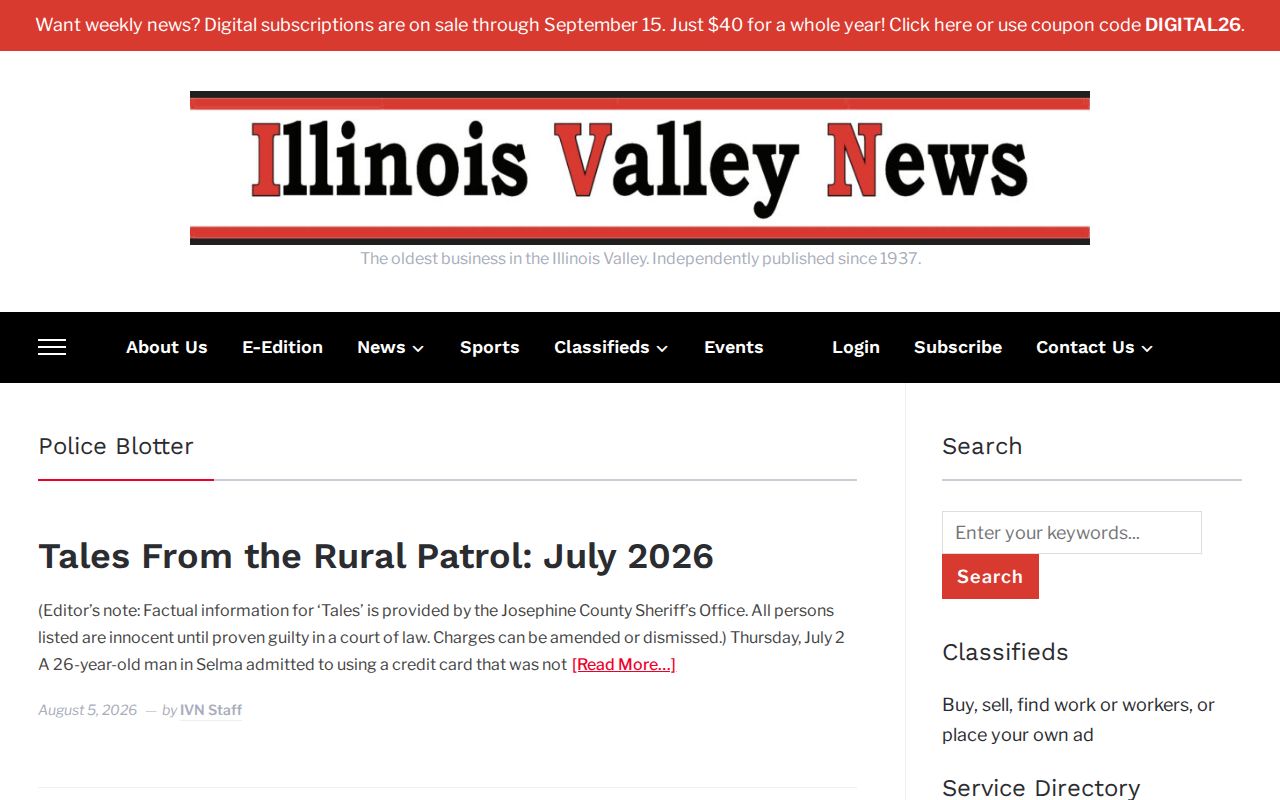
Illinois Valley News stands out for its focus on the county's western and rural communities. Its Police Blotter and Tales From the Rural Patrol archive runs at roughly a monthly pace. Coverage often includes Cave Junction, Kerby, Selma, and broader Illinois Valley calls. The paper says its factual material comes from JCSO. It cautions that charges can change. It also notes that a sheriff reporting-system change limited entries to citations and arrests.
The Illinois Valley News Police Blotter is shown below. The pattern works well for a rural story lead. It is a narrative source, though, not a booking portal or photo gallery.
Need the city angle? The Cave Junction records guide lays out how contract policing works there, why the JCSO roster matters, and where the rural-patrol archive fits into the picture.
Josephine Booking News Briefs
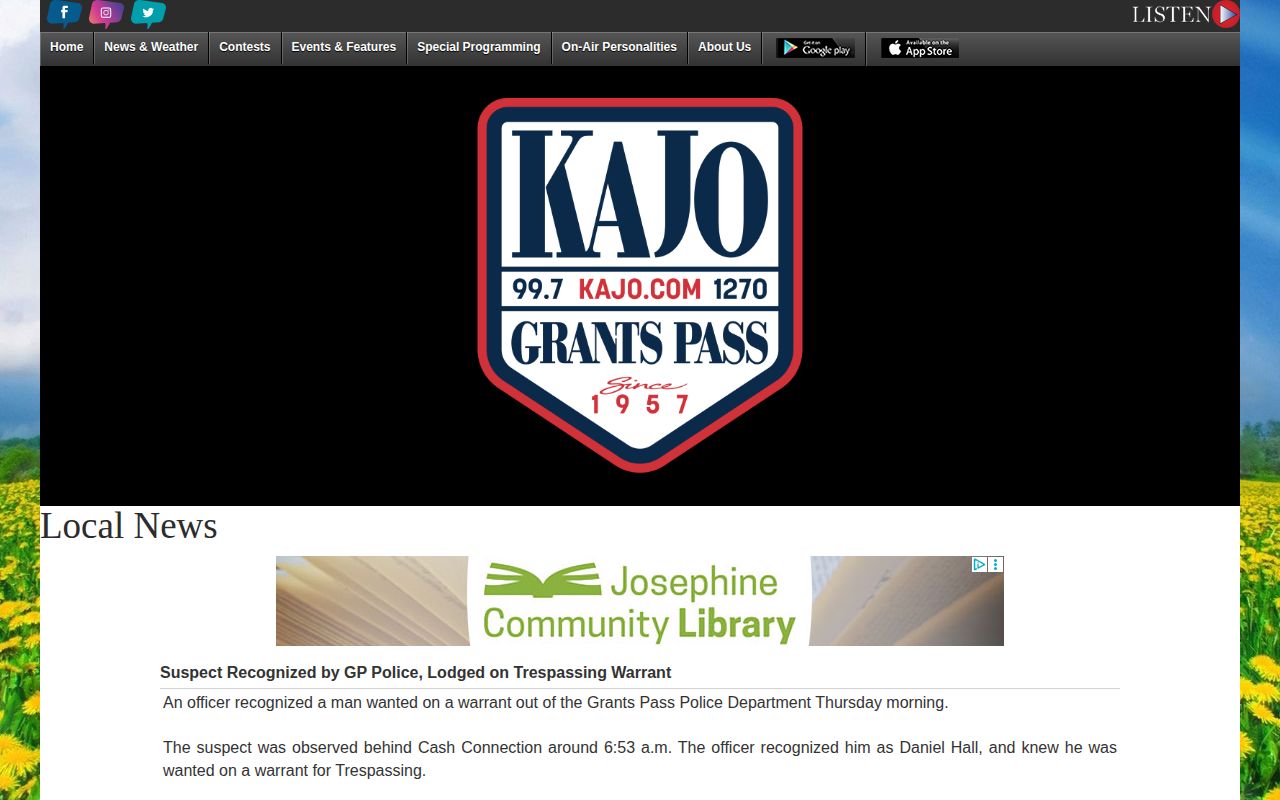
KAJO works a different beat. Its local pattern leans on short, time-stamped reports that name an agency, sketch the circumstances of an arrest, and note whether someone was lodged or released. Later developments sometimes follow. Coverage centers on Grants Pass, though other Josephine County communities appear too. Attribution shifts from piece to piece, drawing on agencies, dispatch traffic, jail logs, deputy reports, or narrative follow-ups. That mix makes a fresh records check worthwhile before treating any status as current.
The KAJO local-news index appears below. A brief can point you to an incident date, but it is not an official booking feed.
KRRM runs its own regional news feed. It can surface stories KAJO missed. Just watch for overlap. When both outlets carry the same arrest story, you are reading one event reported twice, not two separate confirmations of a booking.
Josephine Court Outcome Records
A booking record marks where a court case begins. It does not mark where it ends. JCSO detail screens sometimes list a court date, a courtroom, a docket number, or booking-level disposition wording, and those items work best as leads. The Oregon Judicial Department notes that the court register holds the later filings, hearings, notices, trials, and judgments, though the underlying documents are not always posted online. So when a news arrest leaves you wondering what finally happened, the court record is where you look.
Three routes work. The OJD Records and Calendar Search offers free basic information when available. OJCIN provides a subscribed public-case service, and Josephine County Circuit Court has its own records process. Restating the original news wording will never show a later dismissal, a changed charge, an acquittal, a plea, or a judgment. That gap is exactly why stories, booking records, and court outcomes belong in separate mental files.
Note: A missing free-search result does not prove no case exists, since access rules, timing, or protected record categories can all block what appears.
Josephine Secondary County Pages
The independent county pages each behave differently. RecentlyBooked offers a Josephine County landing page with a 30-day view and multiple daily refreshes. Its cards can carry a name, booking date, and view count, with details sometimes showing other booking-labeled information. The service states plainly that Josephine County does not supply mugshot images. Treat it as a secondary reporting surface, never as proof the jail currently displays a photo or that a person is still in custody.
Mugshots.com has a Josephine County section with alphabet browsing and city labels. Its date navigation looks historical, though, reaching from 2011 to 2017. Some sampled entries list no image at all. Arrests.org has a dedicated county page plus name and county filters, yet its recent window can sit at zero while older entries remain findable. Given these gaps, a third-party page should never stand in for a current county booking feed.
Corrections work differently too. Each publisher keeps its own information and correction process, so a documented court result or official correction should go straight to the source that printed the item. For the underlying event and outcome, the county roster, the Records Division, and Circuit Court remain the official paths.
Josephine Release Stream Boundaries
No official county page carries a title like today's bookings, last 24 hours, last 48 hours, or weekly arrest log. The official date-window route is the JCSO inquiry's Booking From Date and Booking To Date fields. JCSO FlashAlert and its document center put out selective releases. GPPD FlashAlert is selective too. Both may announce a particular arrest or lodging, but neither claims to list every adult booking.
That distinction matters most when news moves fast. A same-day story can precede a roster result, follow it, or skip it entirely. So use the date range for booking questions. Use the release for the announced incident. Use the court for the case outcome. No single source replaces the others.